Aragh, the Persian raisin spirit
What Iranians drink, how it is made, where it is made today, and how to mix and pair it
One word, two drinks
Ask for aragh in an Iranian grocery and you get a bottle of mint water or willow-blossom water: araghiyat, the herbal distillates that every household keeps for stomach aches and summer sharbats. The word simply means a distillate. Add one more word, sagi, and you are talking about something else entirely: the clear, strong, raisin-born spirit that Iranians have drunk for as long as anyone can remember, and that has been illegal to make, sell or drink in Iran since 1979.
The name is a joke that stuck. In the 1960s the Meykadeh company of Qazvin sold its aragh with a beagle on the label, and people started asking for the “doggy” one. In Persian sag, dog, also does duty as an intensifier, the way English says “dog-tired”: the dog on the bottle and the kick in the glass became one word.
Where it comes from
Iran drank before it distilled. Shiraz was famous for its wine by the ninth century, and European merchants were shipping it home by the seventeenth; the Zoroastrian liturgy gave wine a ritual place long before that. Distillation came later, with the alchemists, and the word for it came with the Arabic araq, sweat, for the drops that bead on the cool side of a still. By the Qajar era, Armenian, Assyrian, Jewish and Zoroastrian families, the communities for whom alcohol was never forbidden, ran the stills and the taverns, and aragh-e keshmesh, raisin aragh, was the ordinary strong drink of the country, with date aragh in the south and mulberry aragh in the Armenian villages.
The twentieth century made it an industry. Qazvin and Yazd had commercial distilleries, bottles carried labels and excise stamps, and by the 1970s some three hundred wineries worked the vineyards around Shiraz and the Zagros. All of it stopped in 1979. The religious minorities kept a narrow exemption for their own use; everyone else kept drinking, but now from kitchen stills and the back of a car. That is where aragh sagi has lived for nearly half a century: made in bathtubs and converted pressure cookers, sold in reused water bottles, poured at every party where the music is loud enough, and feared, rightly, because a bad batch can blind or kill. Methanol poisonings from counterfeit and home-made alcohol are reported in Iran every year.
How it is made
The raw material is the humblest thing in the Iranian pantry: raisins, usually sun-dried Thompson seedless, the kind that pile up in every bazaar. The method, in its honest form, is simple and slow.
- Soak. Raisins go into clean water, roughly one part fruit to three or four parts water, and swell for a day.
- Ferment. The sugary water is left in a warm place for two to four weeks. Wild yeast on the raisins, or bread yeast if the maker is in a hurry, turns it into a rough, cloudy raisin wine of eight to twelve percent.
- Distil. The wine goes into a copper pot still, or whatever stands in for one. The first drops, the sar, the heads, are rich in methanol and should be thrown away; a careful maker discards them and the tail end too, keeping only the heart. Home producers in Iran often cannot afford to, and simply run the fire hot to get as much as they can.
- Dilute and rest. The heart comes off the still at sixty to seventy percent and is cut with water to somewhere between forty and fifty-five. Commercial versions rest in steel or glass for a few months. There is no oak, no sugar, no anise: aragh sagi is clear and dry.
Properly made it tastes of what it is. The nose is dried fruit, raisin and a little fig, with a faint caramel from the sugars; the palate is clean, slightly oily, with the grape-skin bite that people compare to grappa. Badly made it tastes of nothing but heat.
Its cousins
Every grape country has a spirit like this, and placing aragh sagi among them is the quickest way to understand it.
- Pisco (Peru and Chile) is the nearest relative in the glass: a clear, unaged grape spirit distilled in copper pots from fresh must rather than raisins, with the Peruvian rules forbidding anything added after the still. Pisco is fruitier and softer; aragh is drier and more raisined. Any recipe that works with pisco works with aragh.
- Grappa and tsipouro (Italy and Greece) are distilled from pomace, the skins and seeds left after winemaking, which gives them the same grape-skin edge Iranians recognise in aragh.
- Zivania (Cyprus) is a pomace spirit the Cypriots themselves describe as smelling of raisins, at about forty-five percent.
- Rakı, ouzo and Levantine arak are the aniseed branch of the family. Turkish rakı is traditionally made from suma, a raisin spirit, before the anise goes in, and Lebanese arak starts from grape spirit; both are drunk with water and ice, turning milky, and with a table of meze. Iranian aragh has no anise and stays clear, but the way it is drunk, with food and company, is the same.
Who makes it today
Inside Iran, nobody legally. Outside, a small and growing number of distilleries make a legal, tested, labelled aragh for the diaspora, and increasingly for everyone else.
- SAG, New York. Four Iranian expats working with the Nahmias family at their distillery in Yonkers. Californian Thompson seedless raisins are soaked and fermented naturally for weeks, then distilled in copper pot stills; the result is a clear spirit described as tasting of dried fruit, molasses and caramel. It has become a fixture of Iranian gatherings in New York and is on the back bar of a growing number of cocktail bars.
- Arak Saggi, Ontario. Bruce Khabbazi, born Behrouz in Shiraz, founded the Persian Empire Distillery in Peterborough in 2006 and makes a triple-distilled arak from Californian raisin paste. The back label carries the old toast masti o rasti, drunkenness and truthfulness.
- Cyrus Premium Arak, the Netherlands. Small-batch, copper-pot distilled from raisins sourced from Iran and Turkey, bottled at forty percent.
Reports mention a handful of other small European producers; if you know one, tell us and we will add it.
How Iranians drink it
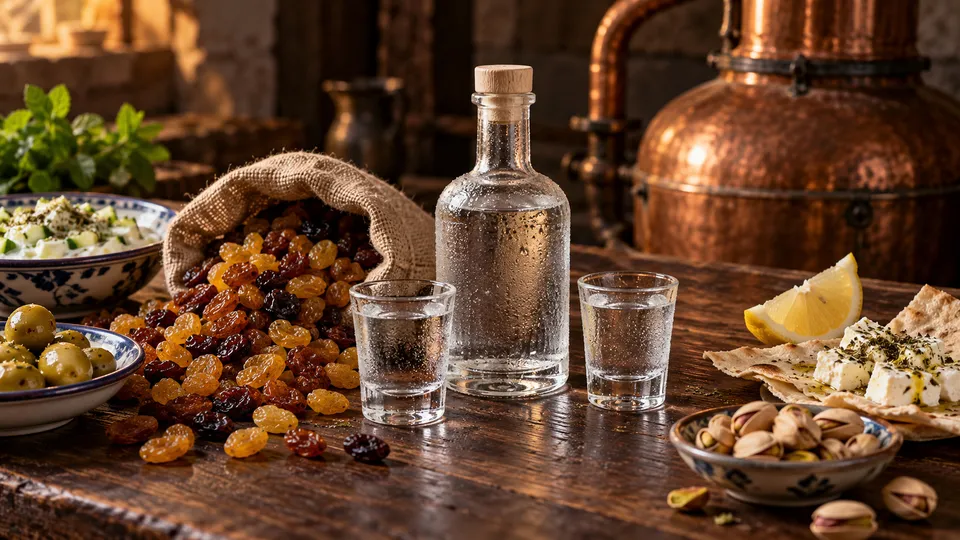
Neat, cold, small and often. A bottle of aragh goes into the freezer and comes out syrupy; it is poured into small glasses, not much more than a mouthful, and raised with be salamati, to health. Nobody sips it alone. The glass is followed immediately by something from the mazeh, the spread that is the whole point of the evening: a saucer of yogurt with cucumber and dried mint, pickled garlic and torshi, feta with walnuts and herbs on a square of lavash, salted pistachios, olives, slices of cucumber with salt, and when the night is serious, kebab. The chaser is often doogh, salted yogurt drink, or a wedge of lemon with salt, or a glass of sour-cherry sharbat. Some dilute it with water and ice like the Lebanese; most do not. The rhythm is a shot, a bite, a story, a song.
Mixing with aragh
Treat it as you would an unaged brandy: pisco, grappa, young calvados. It wants acid, a little sugar and something from its own table.
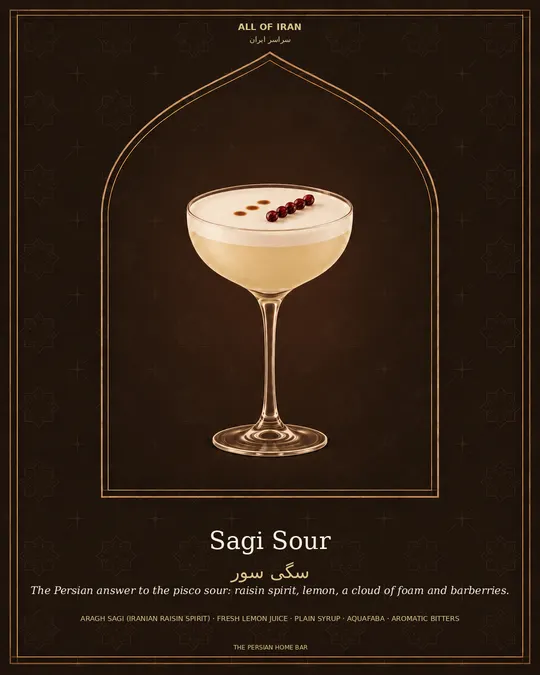
- As a sour. Fifty millilitres of aragh, twenty-five of lemon, fifteen of syrup and a foam of aquafaba or egg white is the easiest introduction. Our Sagi Sour adds two dashes of bitters and a line of barberries on the foam.
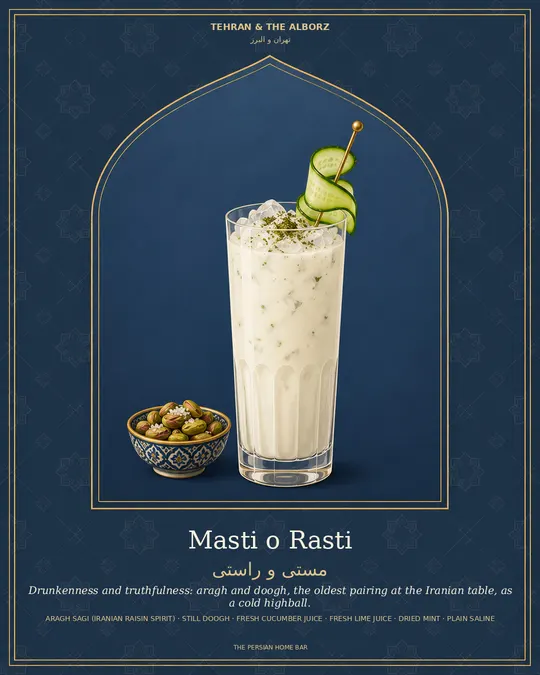
- With doogh. The folk pairing of aragh and doogh becomes a long drink in Masti o Rasti: aragh, still doogh, cucumber juice and dried mint over ice, savoury and cold, named for the toast on the Ontario bottle.
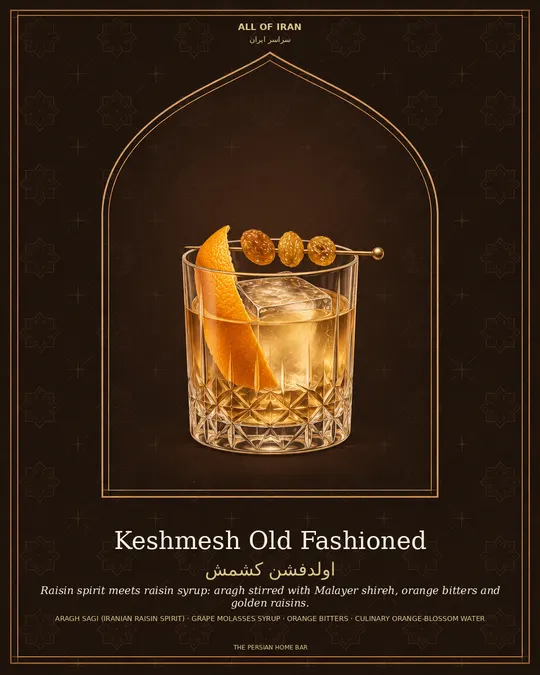
- With its own fruit. Raisin spirit and grape molasses belong together. Keshmesh Old Fashioned stirs aragh with a spoon of Malayer shireh and orange bitters and garnishes it with golden raisins on a pick.
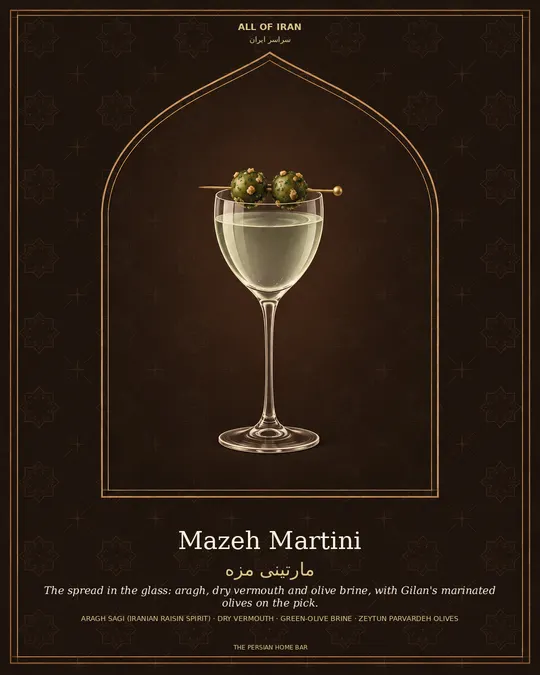
- As a martini. Aragh, dry vermouth and a splash of olive brine, with Gilan’s marinated olives in the glass: the Mazeh Martini puts the spread into the drink.
- Substitutions. If you cannot find aragh, unaged pisco is the closest; grappa, zivania or a clear raisin brandy come next. Vodka works for the long drinks but loses the raisin.
The Saaghi aragh list
Aragh takes every frame a bar can give it: a sour, a stirred glass, a long drink, a bitter one. Our list follows the rules of this whole collection:
- Something from the Iranian pantry does the work in every drink, made in our kitchen: a sharbat, a cordial, an infusion. Never a bought liqueur standing in for Iran.
- The name is a thing, a place or a memory, in Persian, never a pun on a brand.
- The garnish comes from the sofreh: lavashak, a heart of romaine, golpar, a radish, zeytun parvardeh.
- Each drink has a Persian taste word (torsh, shirin, shoor, talkh, tond) and a food to eat with it.
- Measured in millilitres, honest about status: every one is a draft until it has been tasted.
Nine more drinks built on it:
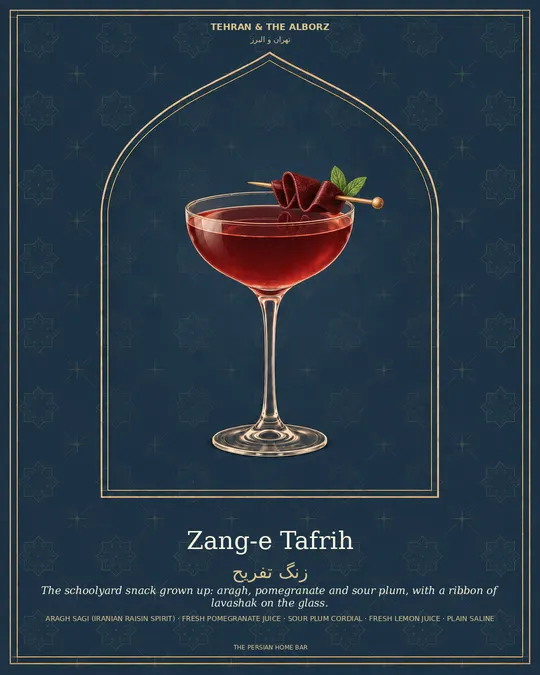
- Zang-e Tafrih: pomegranate and our sour plum cordial, a ribbon of fruit leather on the glass.
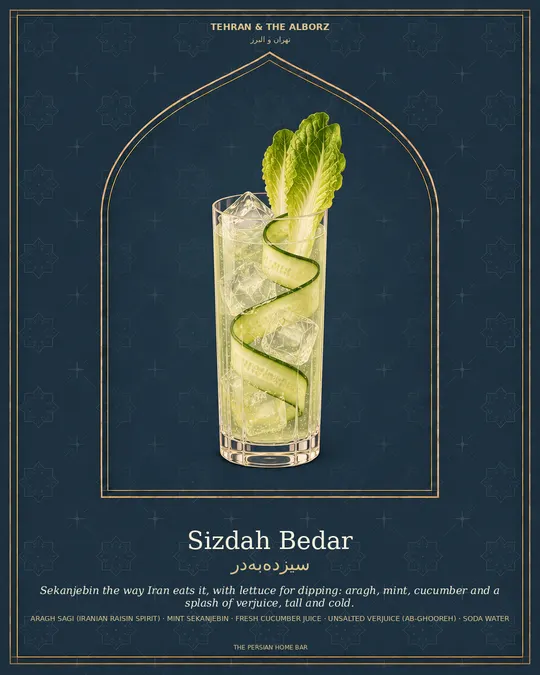
- Sizdah Bedar: the sharbat you dip lettuce in, tall, with verjuice instead of cider vinegar.
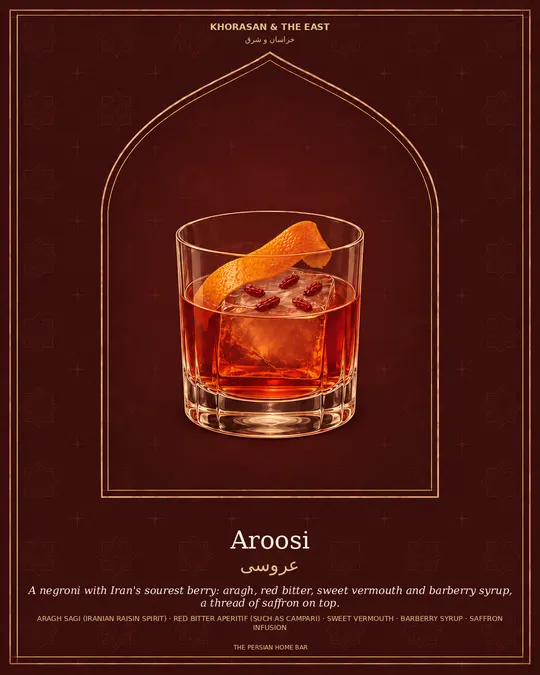
- Aroosi: barberry syrup and two drops of saffron from South Khorasan.
- Bandari: our ginger syrup and dried lime syrup, the Persian Gulf’s two limes.
- Shab-Bidar: cardamom coffee, date syrup and salt; no coffee liqueur.
- Seh Angoor: raisin spirit, verjuice and Malayer grape molasses, three grapes in one glass.
- Sabzi Khordan: a cordial of tarragon, basil and mint, a radish floating.
- Tameshk: Caspian blackberries and purple basil with honey.
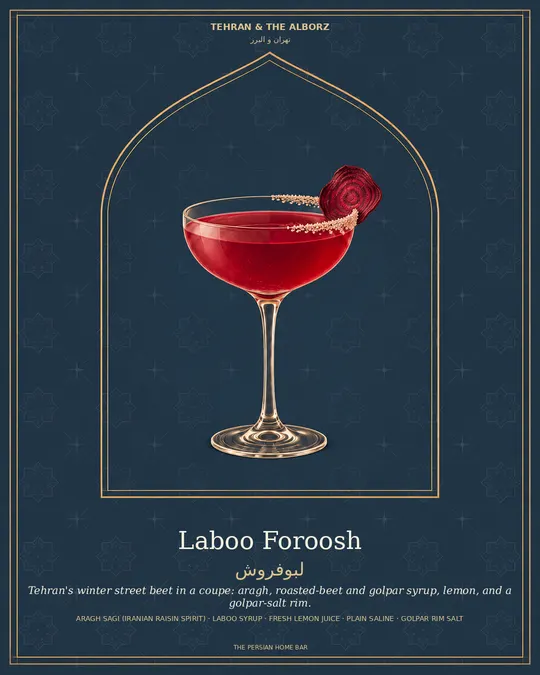
- Laboo Foroosh: roasted-beet and golpar syrup, a golpar-salt rim.
Pairing
Pair it the way Iranians already do. Salt and sour against its heat: yogurt with cucumber, torshi, olives, feta and herbs, pistachios. Grilled things: koobideh, joojeh, grilled tomatoes with sumac. Dried fruit at the end, since the spirit is made of it: raisins, mulberries, dates, a square of gaz. With the sour and the martini, keep to the cold mazeh; with the old fashioned, bring out the kebab and the walnuts.
A note on safety
Nothing on this site should be read as encouragement to distil at home. Home distillation is illegal in many countries and dangerous everywhere: the heads of a run carry methanol, and the poisonings that kill people in Iran each year come from exactly that. Buy aragh from a licensed distiller, drink it slowly, with food, and with people you love.
- Wikipedia: Aragh Sagi
- Forbes: An illegal Iranian spirit finds its place in New York City (2026)
- AP: Raisin moonshine banned in Iran enjoys resurgence in New York
- AP: Canadian arak resurrects bygone Persian drink era (2019)
- SAG NYC: About
- Wikipedia: Alcohol in Iran
- The Revealer: Persian wine, made with Swedish spirit
- The Whisky Exchange: Pisco guide
- Wikipedia: Zivania
- Wikipedia: Rakı
- Wikipedia: Arak (drink)
The drinks
 All of Iran
Sagi Sour
 Tehran & the Alborz
Masti o Rasti
 All of Iran
Keshmesh Old Fashioned
 All of Iran
Mazeh Martini
 Tehran & the Alborz
Zang-e Tafrih
 Tehran & the Alborz
Sizdah Bedar
 Khorasan & the East
Aroosi
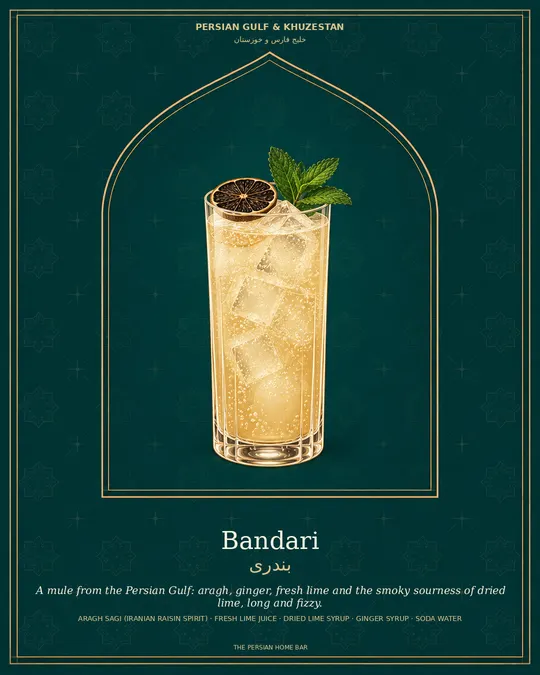 Persian Gulf & Khuzestan
Bandari
 Tehran & the Alborz
Shab-Bidar
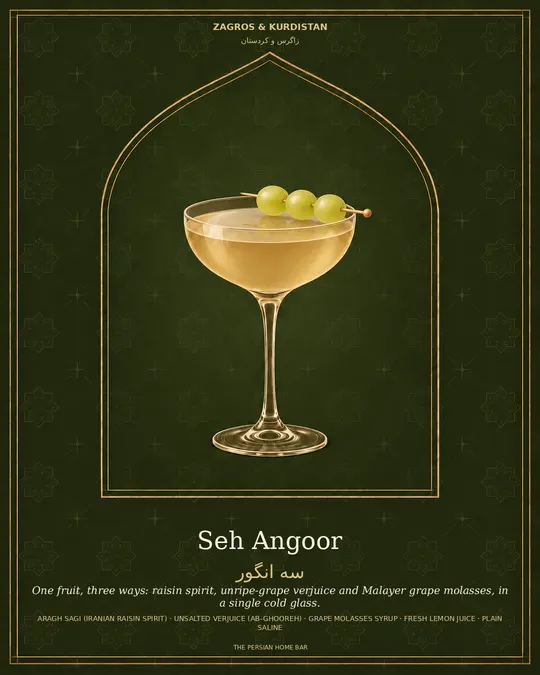 Zagros & Kurdistan
Seh Angoor
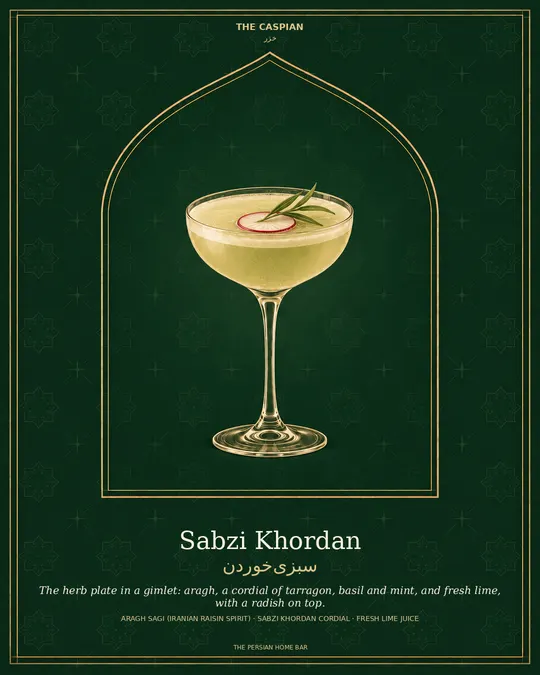 The Caspian
Sabzi Khordan
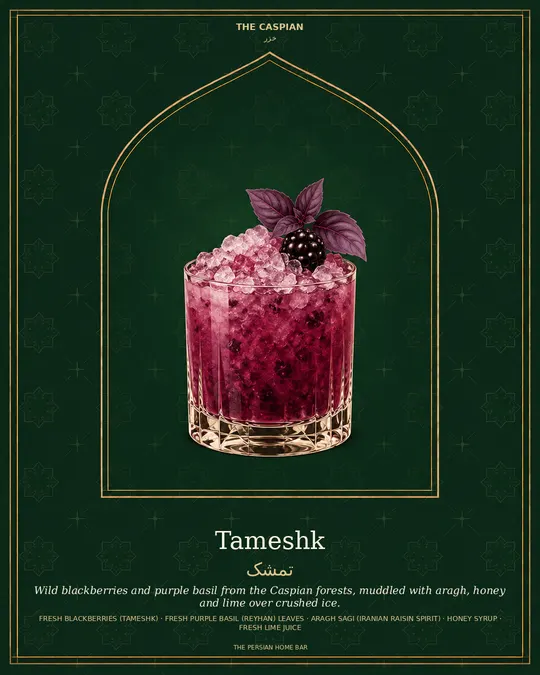 The Caspian
Tameshk
 Tehran & the Alborz